
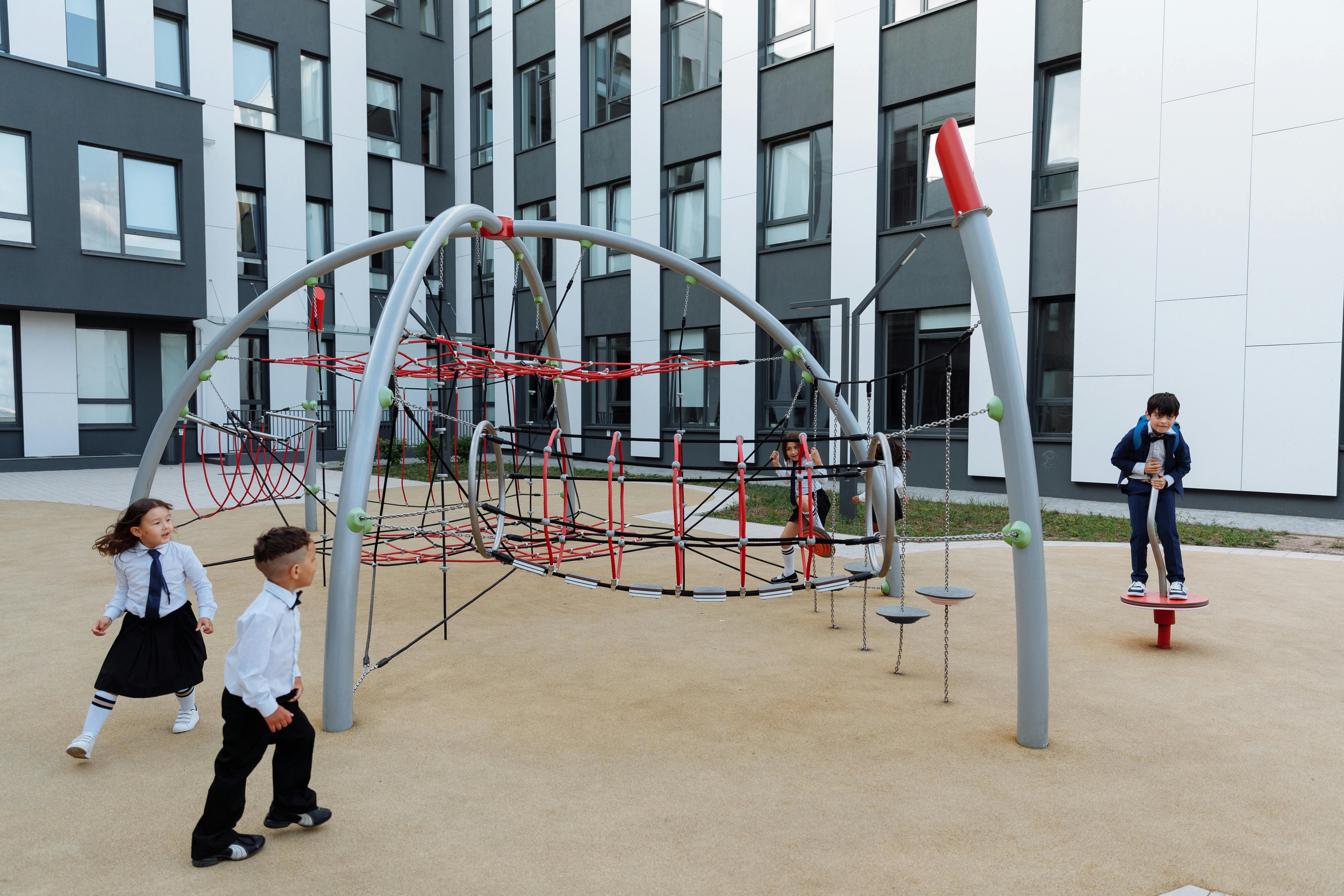
As a teacher, I have spent countless hours observing children in the classroom, witnessing their growth, and guiding their learning. While much of our formal education takes place at desks, in reading circles, and during structured lessons, I have come to realize that some of the most profound learning and development happen outside the classroom walls. Recess and playground equipment are far more than simple breaks in the school day; they are vital elements of a child’s overall growth. Time spent on the playground supports physical health, sharpens social skills, strengthens emotional resilience, and even enhances academic performance. Watching children navigate challenges, cooperate with peers, and explore new ways to move and play, I see firsthand how these unstructured moments contribute to the whole child in ways that formal instruction alone cannot.
The Physical Benefits of Recess
The most obvious advantage of recess is physical activity. In an age when children are increasingly sedentary due to screen time and structured schedules, recess provides a crucial opportunity for movement. As a teacher, I have observed that students who engage in regular physical activity demonstrate better focus, improved mood, and greater energy in the classroom. Climbing, swinging, running, and balancing on playground equipment all engage muscles that may otherwise remain underused. These activities strengthen core muscles, improve cardiovascular health, and enhance coordination and motor skills.
Playground equipment, in particular, plays a critical role in physical development. A swing, for instance, is not just fun; it helps develop balance, coordination, and spatial awareness. Climbing structures challenge children to gauge distances, use their hands and feet in tandem, and develop problem-solving skills in real time. Monkey bars require upper body strength, determination, and resilience, while slides teach children about momentum, gravity, and self-confidence as they navigate both excitement and a degree of fear. When children interact with varied equipment, they exercise multiple muscle groups and learn to navigate their own physical limits safely.
Moreover, recess is an antidote to the prolonged sitting required during classroom instruction. Studies consistently show that children who are given opportunities to move throughout the day demonstrate lower levels of obesity, better posture, and a decreased risk of chronic conditions later in life. In my experience, the students who enjoy structured and unstructured movement during the school day often return to class more alert, attentive, and ready to engage with learning.
Cognitive and Academic Advantages
Beyond physical health, recess and play have profound effects on cognition and academic performance. As educators, we sometimes underestimate the connection between movement and learning. Yet, countless observations and research studies confirm that children who participate in active play are better able to concentrate, process information, and retain new concepts.
One reason is that physical activity stimulates brain function. Movement increases blood flow and oxygen delivery to the brain, which enhances neuronal activity and promotes the growth of neural connections. This stimulation can lead to improved memory, sharper attention spans, and higher cognitive performance. In my classroom, I have seen students who return from recess ready to tackle complex problems with greater focus than when they were seated for extended periods. The break allows the brain to reset, making learning more effective.
Play also encourages problem-solving and creativity. Consider a child navigating a complex climbing structure or inventing a new game with friends. These activities require planning, critical thinking, and adaptability. When children negotiate rules for games, collaborate on creative play, or find new ways to use playground equipment, they practice skills that translate directly into academic tasks such as project-based learning, mathematics, and reading comprehension. Recess is, in many ways, a laboratory for real-world learning, where children apply abstract concepts in concrete, tangible ways.
Social and Emotional Development
One of the most compelling reasons to prioritize recess and playground equipment is their role in social and emotional development. In the classroom, I see children practicing structured forms of cooperation, but the dynamics of unstructured play are quite different. Recess allows children to interact freely, negotiate conflicts, build friendships, and navigate social hierarchies. These are essential skills that cannot be fully cultivated through formal instruction alone.
Playground equipment often serves as a social catalyst. Slides, swings, and climbing structures become meeting points where children interact, communicate, and collaborate. Games that emerge spontaneously on the playground teach children about teamwork, empathy, fairness, and leadership. When a child encourages a friend to try a challenging piece of equipment, or when a group negotiates the rules of a game, they are practicing social-emotional skills that are critical for lifelong success.
From my perspective as a teacher, I have seen countless moments where playground interactions lead to meaningful growth. A shy child may gain confidence mastering the monkey bars or leading a game, while a child learning emotional regulation may practice patience when waiting their turn or handling frustration. These experiences nurture resilience, self-awareness, and social skills that are as important as academic learning.
Furthermore, recess can serve as an emotional release. The school day can be stressful, with academic expectations, social challenges, and behavioral demands. Play provides a safe space for children to release energy, express emotions, and reset their mood. Students who have access to quality recess often return to the classroom calmer, happier, and better able to engage with peers and teachers. In my classroom, recess often prevents minor conflicts from escalating and reduces overall stress levels among students.
Inclusion and Equity
Playgrounds and recess also play a critical role in promoting inclusion and equity. Children come to school with a wide range of abilities, needs, and life experiences, and without thoughtful planning, play spaces can inadvertently exclude some students. A well-designed playground provides opportunities for children of all abilities to participate meaningfully in play, whether they have physical disabilities, sensory sensitivities, or other unique needs. Inclusive equipment, such as ramps, adaptive swings, sensory panels, and wide pathways, ensures that every child can access the physical, cognitive, and social benefits of recess. Even subtle design choices, like providing multiple ways to climb, balance, or move across equipment, can make the difference between a child feeling included or left out.
From my perspective as a teacher, inclusion on the playground extends far beyond accessibility, it shapes the social and emotional development of all students. When children play alongside peers with different abilities, they naturally learn empathy, patience, and cooperation. They discover how to communicate effectively, offer support, and celebrate one another’s successes. These interactions help children build a broader sense of community, fostering an environment where diversity is understood and appreciated.
Recess, therefore, is not just free time; it is one of the most powerful tools schools have for teaching life skills in a natural, enjoyable setting. Through inclusive play, students gain more than physical exercise, they develop social awareness, emotional intelligence, and respect for differences. In this way, a thoughtfully designed playground becomes a living classroom, where the lessons of empathy, equity, and collaboration are learned through laughter, shared challenges, and the simple joy of playing together.
The Role of Outdoor Environments
The outdoor environment itself—parks, green spaces, and playgrounds—enhances the benefits of recess. Nature has a calming, restorative effect on children, reducing stress and promoting positive mental health. Exposure to sunlight provides essential vitamin D and helps regulate circadian rhythms, which supports sleep and overall well-being. Outdoor play also offers sensory experiences that are difficult to replicate indoors, such as feeling the texture of sand, listening to wind through trees, or balancing on uneven surfaces. These experiences contribute to the development of motor skills, sensory integration, and a connection to the natural world.
Playground equipment within these outdoor spaces amplifies these benefits. Swings, slides, climbing walls, and obstacle courses provide structured opportunities for physical challenge, while open spaces allow for creative, unstructured play. Both are necessary. Children learn rules, structure, and safety through equipment-based play, but they also learn imagination, exploration, and self-directed problem-solving through open-ended activity.
Long-Term Life Skills
The lessons learned during recess extend far beyond the playground. Children who regularly engage in active, social, and creative play develop skills that will serve them throughout life. Leadership, negotiation, risk assessment, and emotional resilience are all cultivated in the context of play. Physical literacy, the ability to move confidently and competently in a variety of ways, sets the stage for lifelong health and activity. Creative thinking and adaptability foster innovation and problem-solving in adulthood. Moreover, positive social experiences in childhood create a foundation for healthy relationships later in life.
From my experience, the benefits of recess are cumulative. A child who has daily opportunities for active, cooperative play tends to be more confident, self-assured, and socially adept in adolescence and beyond. These skills are difficult, if not impossible, to fully replicate through classroom instruction alone.
Challenges and Considerations
Despite the clear benefits of recess and playground equipment, many schools face challenges in providing enough opportunities for play. Limited budgets, tight outdoor spaces, and pressure to focus on academics often mean shorter recess periods or fewer pieces of equipment. From my perspective as a teacher, the effects are immediate. Students without enough playtime can become restless, distracted, or socially withdrawn. Minor conflicts escalate more easily, and some children struggle to engage fully in lessons afterward.
Play is more than just fun, it is essential for growth. Quality playground equipment gives children the chance to move, explore, and test their limits in safe ways. Swings, climbing structures, and open play areas help develop strength, coordination, and confidence, while also encouraging cooperation and social interaction. Even small improvements, like adding balls, jump ropes, or a few climbing challenges, can make a significant difference.
Recess also provides a mental reset. Children return to class calmer, more focused, and ready to learn. By investing in playtime and equipment, schools show that a child’s well-being, social skills, and emotional health are valued alongside academics. Playground time is not a luxury, it is a necessary foundation for both learning and healthy development.
Recommendations for Effective Play
Based on my experience and observation, several principles can maximize the benefits of recess and playground equipment:
- Frequency and Duration: Children need multiple breaks throughout the day, not just a single recess period. Regular movement supports attention, mood, and overall health.
- Variety of Equipment: Providing a mix of swings, slides, climbing structures, and open spaces allows children to develop different skills and meet diverse interests and abilities.
- Inclusive Design: Playgrounds should be accessible to children with disabilities, offering ramps, adaptive swings, and sensory experiences.
- Supervised Freedom: Teachers and staff should supervise for safety but allow children the autonomy to make choices, take risks, and resolve conflicts independently.
- Integration with Learning: Educators can integrate play with learning objectives, such as encouraging counting on the playground, exploring science concepts through nature, or fostering teamwork in group games.
- Connection to Nature: Whenever possible, play areas should incorporate natural elements like trees, grass, sand, and water to enhance sensory experiences and foster a connection to the environment.
Conclusion
As a teacher, I can confidently say that recess and playground equipment are far more than simple breaks in the school day. They are essential tools for holistic development, fostering physical health, cognitive growth, social skills, emotional resilience, and lifelong life skills. When we prioritize recess and invest in quality playground equipment, we are giving children the foundation they need to thrive, not only in school but throughout life.
The playground is a place of discovery, joy, and connection. It is a space where children test their limits, learn from each other, and build the skills that cannot be taught at a desk. Observing children at play, I am reminded daily that recess is not optional; it is indispensable. Every swing, slide, and climbing structure is an opportunity for learning, growth, and memory-making. As educators, parents, and communities, it is our responsibility to ensure that every child has access to these vital experiences.
In the words of one of my students after recess one sunny afternoon, “I feel ready for anything now.” That sentiment captures the essence of why recess matters: it prepares children not just for the next lesson, but for life itself.